In brief
- For every boat you see revenue, costs and margin for the season, per hour underway too.
- The year's jobs are in the service history, signed by whoever did them.
- You know what falls due over winter, before you find out in April.
- Missing data is flagged: you know which accounts are complete and which are not.
The problem: in October the numbers are everywhere
Trips sit in the dock log, costs in invoices, jobs in messages with the mechanic, due dates in a spreadsheet. Closing the season means putting it all back together, boat by boat, once the season is already over.
The risk is deciding by eye: renewing the wrong boat, setting next year's rates on incomplete numbers, finding out in spring about a due date that passed in January.
The three questions of an end-of-season review
1. What did each boat earn?
Revenue minus costs, boat by boat. But two boats with similar takings can perform very differently: hours underway count, and so does the time spent laid up at the mechanic.
2. What was done, and by whom?
Services, repairs, replacements: the year's history is what you will show a customer, an insurer or whoever buys the boat. It is worth something if it is complete and if it is clear who did what.
3. What falls due before next season?
Insurance, safety equipment and maintenance don't wait for launch day. A due date in February has to be handled during the lay-up, not discovered on the dock.
What ALFA does when you close the season
Each boat's numbers are already worked out
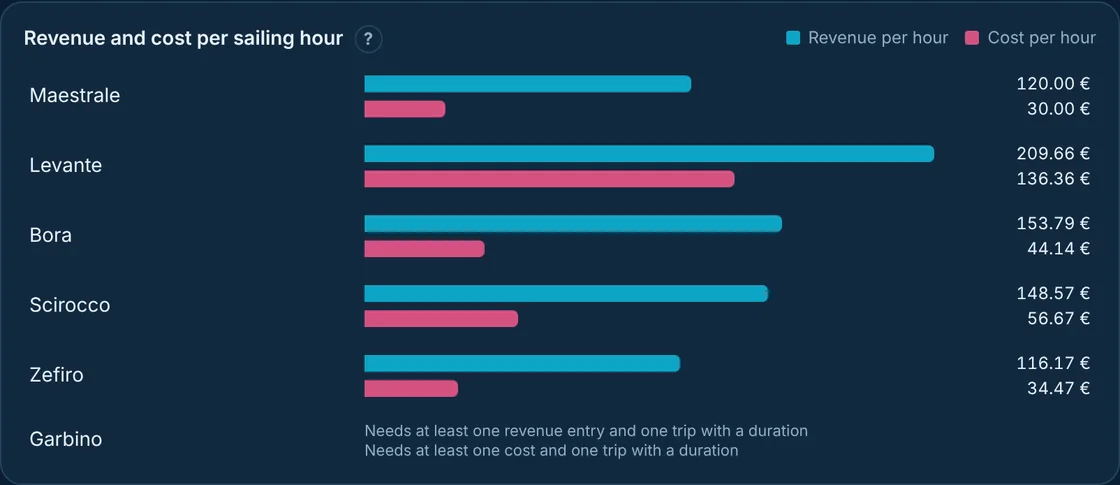
In Plancia, the «Profitability» page shows revenue, costs, margin, hours underway and trips for each boat. With «Compare» you set revenue and cost «Per hour» or «Per trip», and sort the fleet by the column you care about.
If a boat is missing costs, revenue or trip durations, ALFA says so instead of showing a zero: you know which accounts are complete.
The year's history is already in order
Every approved job goes into the service history with the signature of whoever did it, the mechanic or the fleet. At the end of the season there is nothing to copy out.
Winter due dates are already lined up
The schedule sorts the whole fleet's due dates by urgency, including those that fall during the lay-up. Reminders arrive early, with time to get organised.
An example of an end-of-season review
Example with demo data. In October you open Plancia. In «Profitability», on «Per hour», Maestrale leaves a clear margin; Levante, with similar takings, sailed less and costs more for every hour. In the schedule, Grecale's insurance expires in February: you renew it over the winter. Before the boats go ashore, you know which ones to back next year.