In brief
- Fleets: show a customer, an insurer or an inspector a history they can check for themselves, without having to take your word for it.
- Boat owners: when you sell, the buyer can check that no job was added or touched up at the last minute.
- Workshops: your work stays exactly as you signed it. Nobody else can change it in your name.
- For everyone: every change leaves a trace, and the proof sits in a public record that does not depend on ALFA.
A spreadsheet, a notebook or a PDF can be rewritten in a minute, and whoever receives it has no way of noticing. ALFA makes your boat maintenance history verifiable: every job is signed by whoever did it, and every change shows.
The problem: a history that can be rewritten proves nothing
Today a boat's history is scattered across invoices, emails, spreadsheets and the memory of whoever looked after it. Even when it is tidy, it has a flaw: whoever holds it can change it.
- A job can be added later, with a past date.
- An awkward line can be deleted.
- Whoever receives the document cannot tell the original from a touched-up copy.
The risk: the seller's word against the buyer's doubt
- For a fleet: a customer or an insurer asks what was done on a boat. You show a file, and that file is worth as much as your word.
- For a boat owner: the buyer of a used boat haggles precisely because they cannot trust what they read.
- For a workshop: your work ends up in a document others can edit. If someone changes an entry, your name stays under data you never wrote.
How ALFA makes the maintenance history verifiable
1. Every job has a signature
Whoever records a job signs it: the owner, the fleet or the workshop's mechanic. The signature stays tied to the entry.
2. Corrections do not erase: they are added
An entry cannot be deleted or overwritten. If a figure is wrong, only whoever signed it can correct it: the correction becomes a new entry, and the original can still be read. Anyone who did not sign the job can add a dispute, which is recorded too.
3. Every entry is linked to the previous one
Each boat's entries form a chain: each one contains a fingerprint of the one before. Changing a past entry would break the chain, and the check would show it.
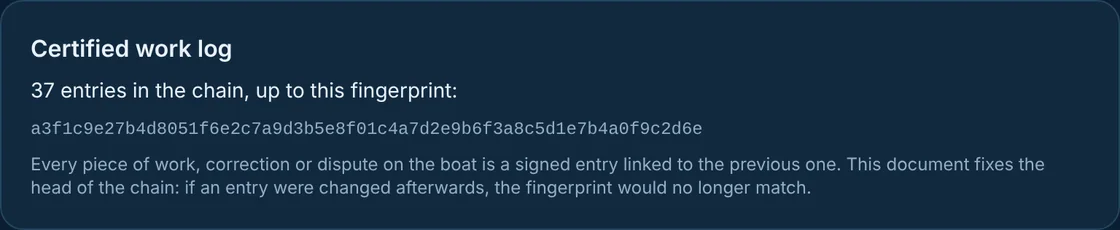
4. Every day the chain is anchored on the blockchain
Every day ALFA records the fingerprint of each boat's latest entry on a public blockchain, using OpenTimestamps, an open and free tool. Only the fingerprint goes on the blockchain: no names, no personal data, no job details.
5. Anyone can check
The on-board document, printed or as a PDF, carries a QR code. Scanning it opens a verification page that shows what was recorded when the document was issued and whether the work log chain is intact. Anyone who wants to do without ALFA too can download the two proof files and check them on opentimestamps.org.
What it guarantees, and what it does not
No system can stop someone from writing false data: whoever signs is answerable for it. ALFA guarantees something else: once signed, any change is detected, including one made by whoever runs the system.
The certified service history collects the work recorded over time on this vessel. Each job is signed by the person who declares having carried it out, who is solely responsible for it. ADC Tech Marine attests only that it has collected and stored this data over time; it does not verify its accuracy and is not liable for false statements or fraudulent use by those who entered them, nor for any resulting damage.
An example: the same job seen by three people
Example with demo data. A rental fleet has a workshop service the engine of one of its boats. The mechanic records the job and signs it on behalf of the workshop. The next day he realises he typed the engine hours wrong: he corrects the entry, and the log keeps both the original figure and the correction, with his signature.
At the end of the season the fleet sells the boat to a private buyer. The buyer receives the on-board document, scans the QR code and sees the jobs, who signed them and the hours correction, with the chain intact. He does not have to trust the fleet or the workshop: he checks.
- The fleet sells a boat with a history that stands on its own.
- The buyer knows what was done, and by whom.
- The workshop sees its work reach the new owner exactly as it signed it.